Myqoriva
Cipher Framework
Cipher Framework
Couldn't load pickup availability
1. Problem Statement
After studying PHP basics, many learners begin to notice that knowing separate syntax rules is not enough for reading or writing fuller scripts. A condition may be clear by itself, but it can feel harder when it sits beside arrays, loops, functions, and submitted values. Learners may also struggle with where to place code, how to name parts clearly, and how to avoid repeating the same lines again and again. Without structure, even a small PHP file can become difficult to review, revise, or explain. Cipher Framework was created for learners who want a more ordered way to study PHP logic and code organization.
2. Solution
Cipher Framework presents PHP through structured written modules that focus on planning, grouping, and reading code with more care. The course helps learners move from separate examples into arranged script sections, reusable functions, array-driven output, and cleaner form-style handling. Each module includes explanations, sample scripts, reading tasks, rewrite prompts, and recap notes. The material is written to help learners build skills gradually through repeated practice and clear examples. This tier is intended for students who want a deeper PHP course while keeping the study flow readable and grounded.
3. What’s Inside
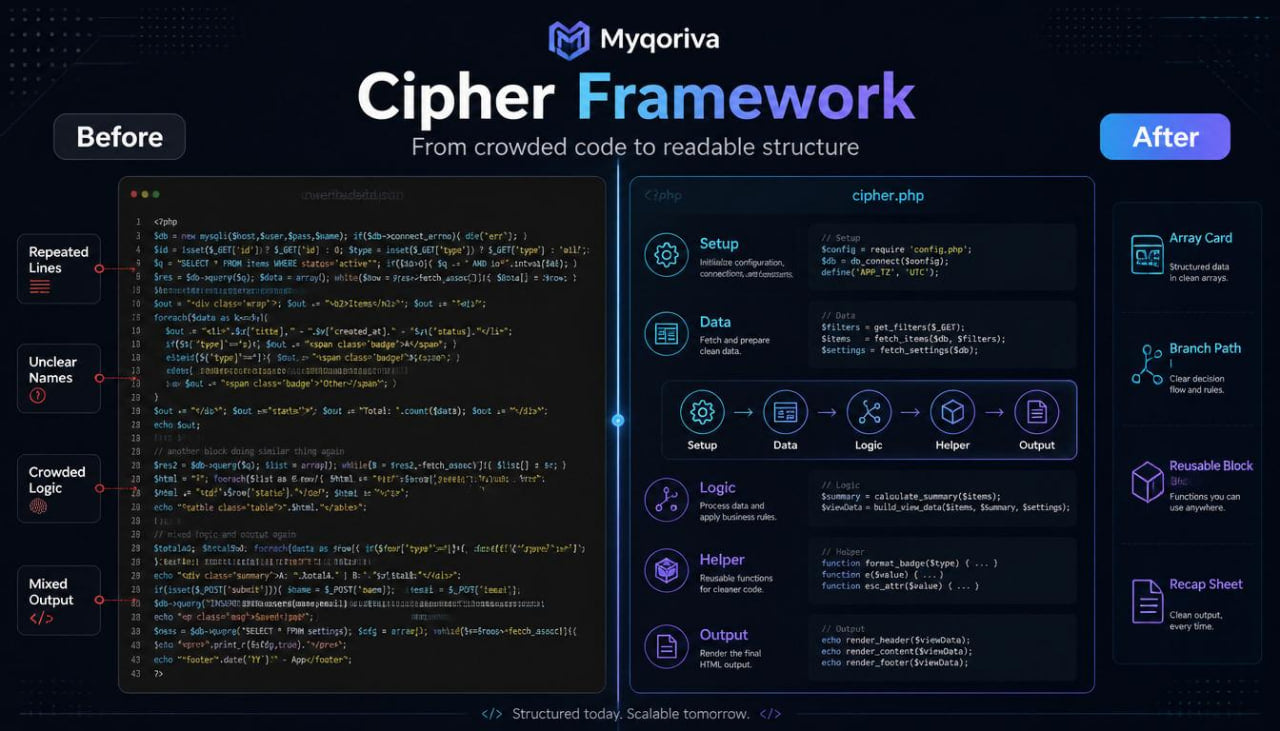
Cipher Framework begins with a module called “Reading the Whole Script.” This section shows how a PHP file can be understood as a set of connected parts instead of isolated lines. Learners review setup values, logic sections, helper functions, data groups, and output blocks. The module explains how to read from top to bottom, how to identify the role of each section, and how to describe what the script is doing in plain language. This opening part gives students a stronger base for the rest of the course.
The next module focuses on naming and structure. Learners study how variable names, array keys, function names, and comments can make code easier to follow. The course shows side-by-side examples of unclear code and cleaner code, then explains why some names are more useful than others. Practice tasks ask learners to rename values, rewrite comments, and group related lines together. This helps develop habits that make PHP examples more readable during study and review.
A larger section works with arrays as structured information. Cipher Framework goes beyond small lists and introduces arrays that hold grouped details, nested values, and repeated data sets. The examples use neutral learning scenarios such as course sections, reading notes, topic groups, and task labels. Learners review how to select values from arrays, how to loop through grouped information, and how to display data in organized output. Each example includes a breakdown of keys, values, and repeated reading patterns.
The course then moves into loops with more context. Learners study repeated output, filtered output, and loops that work with arrays of related values. The module explains how a loop begins, what changes during each round, and when the loop stops. Students work through tasks where they predict output, adjust loop rules, and explain how repeated lines are produced. This section helps learners connect loop behavior with real PHP structure instead of treating repetition as a separate topic.
Cipher Framework includes a detailed function module. This part explains how functions can hold reusable instructions, receive input values, process those values, and return a result. Examples include formatting text labels, checking simple rules, preparing output blocks, and calculating small totals. The materials compare repeated code with function-based code, showing how reusable sections can reduce clutter and make a script easier to revise. Practice prompts ask learners to complete missing parameters, describe returned values, and rewrite repeated code into a reusable block.
A form-style workflow module introduces a more complete flow from submitted values to checked output. Learners study how named fields relate to PHP values, how a script can check whether a field was filled, and how output can be arranged after the check. The examples stay neutral and use simple fields such as name, topic, note, and selection. The module also explains why a script should handle missing or unexpected values carefully. Students complete tasks that involve reading field names, checking values, and preparing a clean response.
Another part of the course focuses on conditional planning. This module shows how conditions can be arranged in a readable order. Learners study single checks, paired checks, multiple branches, and nested conditions. Each example includes a small planning note before the code, so students can see how the logic was shaped before it was written. Practice prompts ask learners to write plain-language rules, match them with PHP conditions, and adjust the order of checks.
Cipher Framework also includes a section on small study pages. Learners review how several PHP ideas can appear together inside one page-style example: setup values, arrays, conditions, loops, functions, and output. These examples are not large applications. They are study-focused pages made to show how core PHP pieces can share one structure. Each page example is followed by a guided reading path that explains the role of every part.
The course includes recap sheets after each major module. These sheets contain short definitions, comparison tables, common mistake notes, and rewrite prompts. They help learners review the difference between a variable and an array, a loop and a condition, a function parameter and a returned value, or a setup section and an output section. The recap sheets are written for repeated reading, so students can return to them after finishing a task.
Cipher Framework ends with a guided practice sequence. This final section combines several topics into one longer example. Learners start by reading the planning note, then review the data array, examine the helper function, follow the condition checks, and trace the loop output. The final practice asks learners to revise the example by changing labels, adding a new condition, and explaining the result in writing. This closing part helps connect PHP structure, logic, and review into one course experience.
4. Who Is This For?
Cipher Framework is for learners who already understand basic PHP syntax and want to study more organized code patterns. It suits students who have worked with variables, conditions, loops, arrays, and functions, but want clearer guidance on how those ideas fit together inside one script. The course is also helpful for learners who want more reading practice, more rewrite tasks, and more structure-focused examples.
This tier may fit someone who has completed earlier Myqoriva levels or has studied beginner PHP elsewhere and now wants a more detailed path. It is not written as an advanced-only course. Instead, it gives learners a bridge between early PHP knowledge and more structured script planning. The materials are useful for self-study because each module can be read separately and then reviewed through recap sheets.
Cipher Framework is also suitable for learners who want to improve code reading habits. The course places strong attention on naming, grouping, comments, reusable sections, and output flow. Students are encouraged to describe code in their own words, trace values through a script, and revise examples with care.
5. What You’ll Learn
- How to read a PHP file as connected sections
- How to identify setup, logic, helper, data, and output areas
- How to choose clearer names for variables, arrays, and functions
- How array keys and grouped values shape structured information
- How loops work with arrays of related values
- How to predict repeated output from a loop
- How reusable functions receive values and return results
- How to compare repeated code with function-based code
- How form-style values can move through a PHP script
- How to check missing or unexpected values in beginner examples
- How to plan conditions before writing them
- How single, paired, and nested checks differ
- How to combine arrays, loops, functions, and conditions in one study page
- How recap sheets can help with repeated review
- How to revise a structured PHP example without losing its reading flow
6. 30-Day Refund Window
Cipher Framework is a paid Myqoriva tariff, and a 30-day refund window may apply according to the store policy shown during checkout and on the refund information page. Learners should review the course description, included materials, topic list, and store terms before placing an order.
Self-paced learning overview
- 📁 Digital file available after purchase
- 🗂️ Long-term availability
- 🔐 Secure checkout
- 📝 Content updated in 2026
Do I need previous PHP knowledge before starting?
Do I need previous PHP knowledge before starting?
No previous PHP study is needed for the starting tiers. The early materials begin with basic ideas such as syntax, variables, values, conditions, loops, and code reading.
Can I study the course gradually?
Can I study the course gradually?
Yes. Each course is arranged into smaller sections, so you can move through the material step by step, return to earlier notes, and repeat practice tasks when needed.
What happens after I choose a tariff?
What happens after I choose a tariff?
After choosing a tariff, you receive the course materials included in that level. Each higher tariff adds wider topic coverage, more practice sections, and deeper review pages.
Share