Myqoriva
Drift Library
Drift Library
Couldn't load pickup availability
1. Problem Statement
After a first look at PHP, many learners understand a few separate ideas but still struggle to connect them into readable scripts. A variable may seem clear in one example, but the same learner may feel unsure when that variable appears inside a condition, a loop, or a form-related task. Arrays can feel especially unclear because they introduce structure, keys, grouped values, and repeated reading patterns. Some study materials jump from one topic to another without giving enough room for review, which can make the learning path feel uneven. Drift Library was created for learners who want a broader PHP study set that keeps the pace organized and gives each topic room to breathe.
2. Solution
Drift Library presents PHP through a wider written course format with structured modules, topic notes, code examples, and guided practice. The course builds on first-step PHP ideas and shows how smaller parts of code can work together inside longer examples. It introduces arrays, forms, conditions, loops, and reusable code patterns in a calm order, so each section supports the next one. The materials include reading tasks, rewrite prompts, recap tables, and comparison notes to help learners return to each topic during review. This tariff is intended for students who want a fuller PHP learning route while still staying in a beginner-friendly study range.
3. What’s Inside
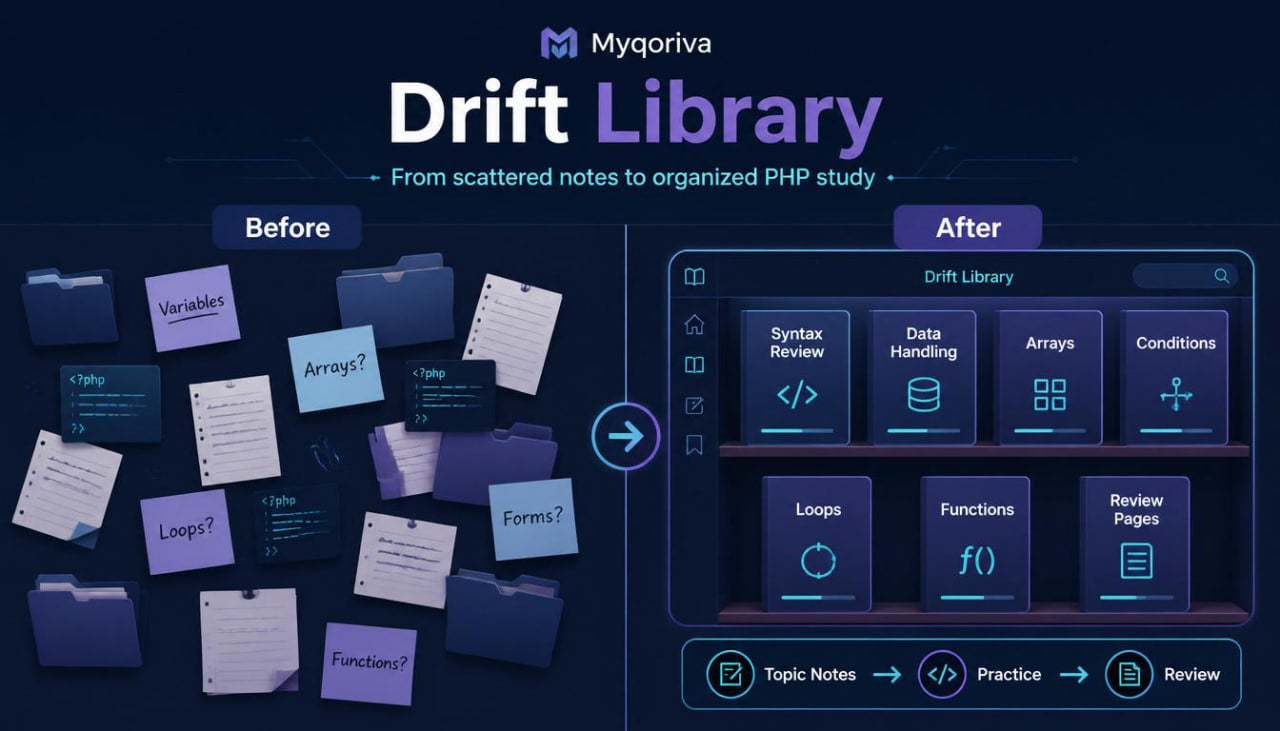
Drift Library begins with a short review of PHP syntax and file structure. This opening part revisits code blocks, statements, quotation marks, semicolons, variables, and output. The review is not written as a repeat of the first tariff; it adds more context and shows how beginner details appear inside larger examples. Learners are asked to read small scripts and identify what each line is doing before moving into new material.
The next module focuses on variables and data handling. It explains how values can be named, updated, combined, compared, and displayed. The materials include examples with text values, number values, and mixed output. You will see how a small change in a stored value can affect later lines in a script. Practice prompts ask you to rename variables, adjust values, predict output, and rewrite small examples with clearer structure.
A larger section introduces arrays. This part explains how PHP can hold grouped values, how indexed arrays are read, and how named keys help organize related data. The course uses plain examples such as lists, labels, settings, and grouped course information. Each example is followed by a reading note that explains how the array is built and how a value can be selected. The goal is to help learners understand arrays as organized containers rather than mysterious blocks of code.
Drift Library also includes a module on conditions. This part goes beyond the earliest examples and shows how conditional logic can handle different cases. You will review comparison operators, combined conditions, nested checks, and branch-style reading. The examples stay small enough to follow, but they are varied enough to show how conditions can shape real script behavior. The practice tasks include “read the branch,” “complete the missing condition,” and “change the rule” exercises.
The course continues with loops and repeated reading. Learners review how repeated actions can reduce copied code and how a loop can move through a sequence of values. The materials connect loops with arrays, showing how grouped values can be read one by one. Each loop example includes a step note that explains what changes during each round. This helps learners follow the movement of the loop instead of only looking at the final output.
A form-focused section introduces the idea of receiving submitted values in a careful, beginner-level way. The course explains how form fields relate to named values and how a script can read submitted text. The materials do not rely on platform-specific examples or third-party names. Instead, they use neutral sample fields such as name, topic, message, and selection. The section includes notes about checking whether a value exists, reading input carefully, and arranging output in a clean format.
Drift Library also contains a module on small reusable structures. This includes beginner-friendly notes on functions, parameters, returned values, and repeated code patterns. The course explains why a function can help keep a script organized when the same action appears more than once. Examples include formatting text, calculating small values, and preparing repeated output. Practice prompts ask learners to read a function, explain the input, and describe what comes out of it.
The course includes review pages after each group of topics. These pages are written as compact study boards with definitions, small examples, common mistakes, and rewrite tasks. A learner can use them after finishing a module or return to them later before moving into a wider tariff. The review pages are especially useful for comparing similar ideas, such as an array and a variable, a loop and a condition, or a function and a repeated block.
Drift Library also includes a small course map. This map shows how the modules connect: syntax leads into variables, variables support conditions, arrays connect with loops, and functions help organize repeated logic. This gives the learner a clearer sense of why the course is arranged in this order.
4. Who Is This For?
Drift Library is for learners who have seen the basics of PHP and want a wider written course with more topic depth. It can suit someone who has completed a small starter pack, read a few beginner notes, or studied PHP before but wants a more organized route. The course is also useful for learners who prefer written modules, code examples, and practice prompts over scattered short explanations.
This tariff is a good fit for people who want more than a tiny sample but are not yet ready for highly advanced PHP topics. It keeps the focus on core reading and writing skills: understanding variables, reading conditions, working with arrays, following loops, and beginning to organize code with functions. It may also suit learners who like to study with recap tables and short tasks after each module.
Drift Library works well for self-paced study. You can read one module, complete several prompts, then return to the recap page before continuing. The course does not ask the learner to rush. It is made for steady progress through PHP concepts, with enough repetition to help each idea feel familiar through practice.
5. What You’ll Learn
- How to review PHP syntax inside wider code examples
- How variables store, update, and display values
- How text values and number values behave in short scripts
- How arrays group related information
- How indexed arrays and named keys are structured
- How to read array values inside examples
- How conditions guide script behavior
- How combined conditions can describe more detailed rules
- How loops repeat actions in a controlled way
- How loops can read values from arrays
- How form-style values can be handled in beginner examples
- How to check whether a value exists before using it
- How functions organize repeated logic
- How parameters and returned values work in small examples
- How to use recap pages for review and repeated practice
- How to connect variables, arrays, conditions, loops, and functions into a clearer study path
6. 30-Day Refund Window
Drift Library is a paid Myqoriva tariff, and a 30-day refund window may apply according to the store policy shown during checkout and on the refund information page. Learners should review the included course materials, tariff description, and refund terms before placing an order.
Self-paced learning overview
- 📁 Digital file available after purchase
- 🗂️ Long-term availability
- 🔐 Secure checkout
- 📝 Content updated in 2026
Do I need previous PHP knowledge before starting?
Do I need previous PHP knowledge before starting?
No previous PHP study is needed for the starting tiers. The early materials begin with basic ideas such as syntax, variables, values, conditions, loops, and code reading.
Can I study the course gradually?
Can I study the course gradually?
Yes. Each course is arranged into smaller sections, so you can move through the material step by step, return to earlier notes, and repeat practice tasks when needed.
What happens after I choose a tariff?
What happens after I choose a tariff?
After choosing a tariff, you receive the course materials included in that level. Each higher tariff adds wider topic coverage, more practice sections, and deeper review pages.
Share