Myqoriva
Free Capsule
Free Capsule
Couldn't load pickup availability
1. Problem Statement
Many beginners meet PHP through scattered fragments, short code snippets, and explanations that do not always connect into a full learning path. This can make the early stage feel confusing because variables, conditions, forms, arrays, and functions may appear before the learner understands how they work together. Some materials explain code in a rushed way, leaving little room for reading, rewriting, and reviewing examples. A new learner may also struggle to understand why a small mistake changes the behavior of a PHP file. Free Capsule was created for people who want a calm entry point before choosing a wider Myqoriva course tier.
2. Solution
Free Capsule gives you a small but carefully arranged PHP study set that focuses on clarity, order, and practical reading. Instead of trying to cover every PHP topic at once, it introduces selected core ideas through short explanations, examples, and guided tasks. The course helps you observe how PHP code is written, how values are stored, how conditions shape logic, and how small scripts can be read line by line. Each section is designed to help you build skills through repetition, notes, and compact exercises. This tariff works as a first study sample for learners who want to understand the Myqoriva course style before moving to a larger tier.
3. What’s Inside
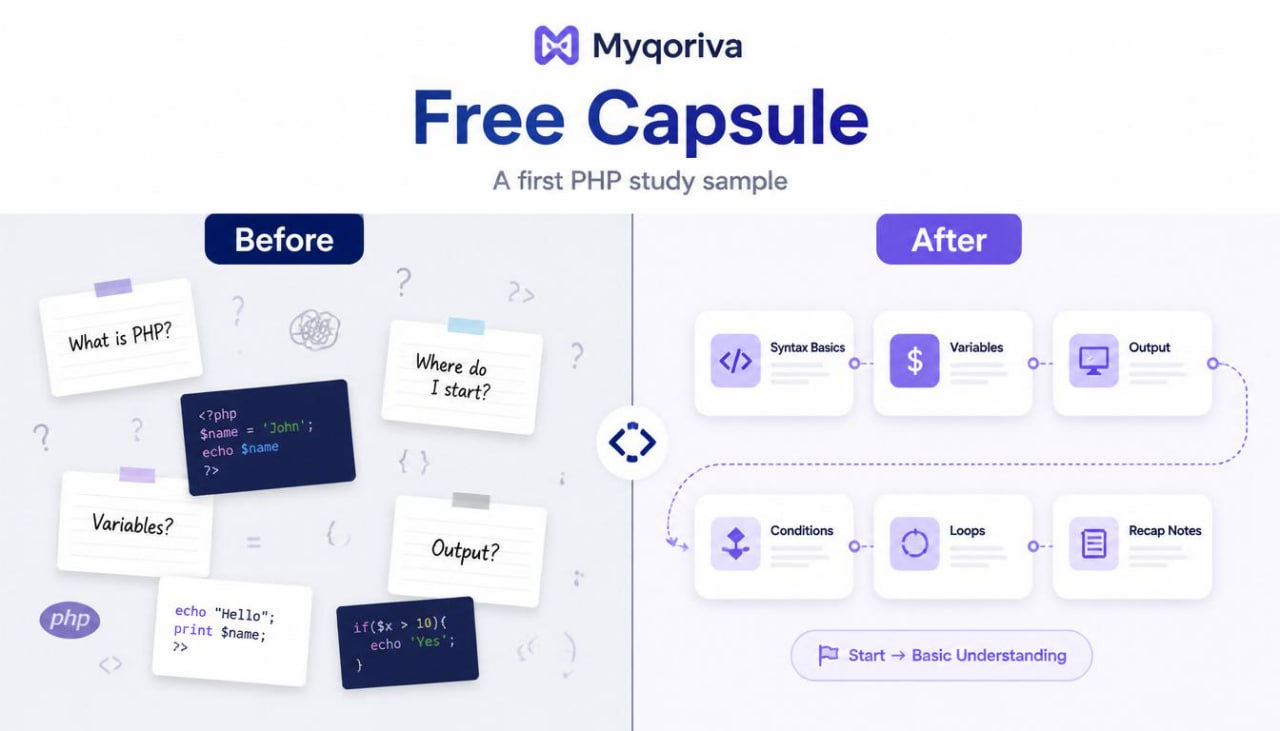
Free Capsule includes a compact set of written PHP learning materials arranged for early study. The course begins with a short orientation section that explains what PHP is used for in broad terms, how PHP code is usually placed inside a file, and how a learner can read the examples without feeling pressured to memorize every detail at once. This opening part introduces the idea of code as a sequence of instructions, where each line has a role and each symbol affects how the script behaves.
The next part focuses on PHP syntax basics. You will see how PHP code blocks are written, how statements are formed, and how small syntax details such as semicolons, quotation marks, and brackets shape the result of the code. The materials do not simply show examples; they also explain what each part is doing in plain wording. This helps the learner slow down and notice details that often cause confusion during early practice.
Free Capsule also includes a section on values and variables. This part explains how text, numbers, and basic stored values can be named and reused inside a PHP script. You will review examples where a variable is created, changed, combined with another value, or printed as part of an output. The goal is to make the learner comfortable with reading variable names and understanding how data moves through a short PHP example.
A separate section introduces basic output. This part shows how PHP can display text and values, how static text differs from stored values, and how small output examples can be tested mentally before writing code. The materials include practice prompts where the learner reads a short script and describes what the output should be. This supports code reading as well as code writing.
Free Capsule also includes an introductory logic section. You will see how conditions help a script make decisions. The materials explain comparison ideas such as equal values, greater values, smaller values, and different values through plain examples. This section does not go too deep into complex structures; it keeps the focus on reading condition blocks and understanding how one path can run while another path does not.
There is also a short practice section on repeated actions. This introduces loops in a controlled way. The materials show how repeated code can reduce manual writing and how a counter can guide repeated output. The examples are small, so the learner can follow each step without losing track of what changes from one round to another.
To support review, Free Capsule includes recap notes after each topic. These notes summarize key ideas in short paragraphs and small reference tables. The recap pages are useful for returning to a topic after a break. They also help learners compare similar ideas, such as a value and a variable, a condition and a loop, or text output and variable output.
The course also contains mini practice tasks. These are not large projects. They are small reading and writing prompts made for careful study. Some ask you to complete a missing line. Some ask you to explain what a code example does. Others ask you to rewrite a short example with a different value or condition. This format helps the learner study PHP in a steady and practical way.
Free Capsule ends with a short review checklist. This checklist helps you see which beginner topics you have already reviewed and which ones may need another reading. It also gives a gentle bridge toward the next Myqoriva tariff, where the learner can continue with broader PHP materials, more examples, and wider practice sections.
4. Who Is This For?
Free Capsule is for learners who are curious about PHP and want a small starting point before choosing a wider course tier. It is suitable for people who have not studied PHP before, as well as people who once saw PHP code and want a cleaner reintroduction. The course can also be useful for learners who prefer written materials, compact explanations, and practical tasks instead of long lectures or scattered notes.
This tariff is also a good fit for someone who wants to understand the Myqoriva teaching style. Since Free Capsule is smaller than the paid tiers, it gives a clear sample of how the materials are structured, how examples are explained, and how practice tasks are arranged. It is not meant to cover every beginner topic in depth. Instead, it gives a narrow and useful opening into PHP syntax, variables, output, conditions, loops, and review habits.
Free Capsule may also suit learners who like to study in short sessions. The sections are compact enough to read during a quiet break, after work, or as part of a weekend study plan. You can read one topic, try a few practice prompts, and return later without losing the thread of the material.
5. What You’ll Learn
- How to recognize the basic shape of a PHP code block
- How PHP statements are written and separated
- How text values and number values appear inside code
- How variables store and reuse information
- How output examples display text and stored values
- How to read short scripts line by line
- How conditions guide different code paths
- How comparison logic appears in beginner PHP examples
- How repeated actions can be introduced through loops
- How to complete small code reading tasks
- How to use recap notes for review
- How to spot common syntax details such as brackets, semicolons, and quotation marks
- How to build a study rhythm before moving into wider PHP materials
- How Myqoriva course sections are organized
- How practice prompts can support steady PHP learning
6. 30-Day Refund Window
Free Capsule is a no-cost starting tariff, so there is no payment required for this course level. For paid Myqoriva course tiers, a 30-day refund window may be offered according to the store policy shown at checkout and on the refund page.
Self-paced learning overview
- 📁 Digital file available after purchase
- 🗂️ Long-term availability
- 🔐 Secure checkout
- 📝 Content updated in 2026
Do I need previous PHP knowledge before starting?
Do I need previous PHP knowledge before starting?
No previous PHP study is needed for the starting tiers. The early materials begin with basic ideas such as syntax, variables, values, conditions, loops, and code reading.
Can I study the course gradually?
Can I study the course gradually?
Yes. Each course is arranged into smaller sections, so you can move through the material step by step, return to earlier notes, and repeat practice tasks when needed.
What happens after I choose a tariff?
What happens after I choose a tariff?
After choosing a tariff, you receive the course materials included in that level. Each higher tariff adds wider topic coverage, more practice sections, and deeper review pages.
Share