Myqoriva
Slate Unit
Slate Unit
Couldn't load pickup availability
1. Problem Statement
Many learners reach the middle stage of PHP study with a mix of known ideas and unclear connections. They may understand variables, arrays, and conditions separately, but still feel uncertain when those parts appear together in one script. A PHP file can become difficult to follow when data, logic, repeated actions, and output are not arranged in a readable order. Learners may also need more practice with revising code, because reading a finished example is different from improving or adjusting it. Slate Unit was created for students who want structured PHP materials with more guided practice and clearer script organization.
2. Solution
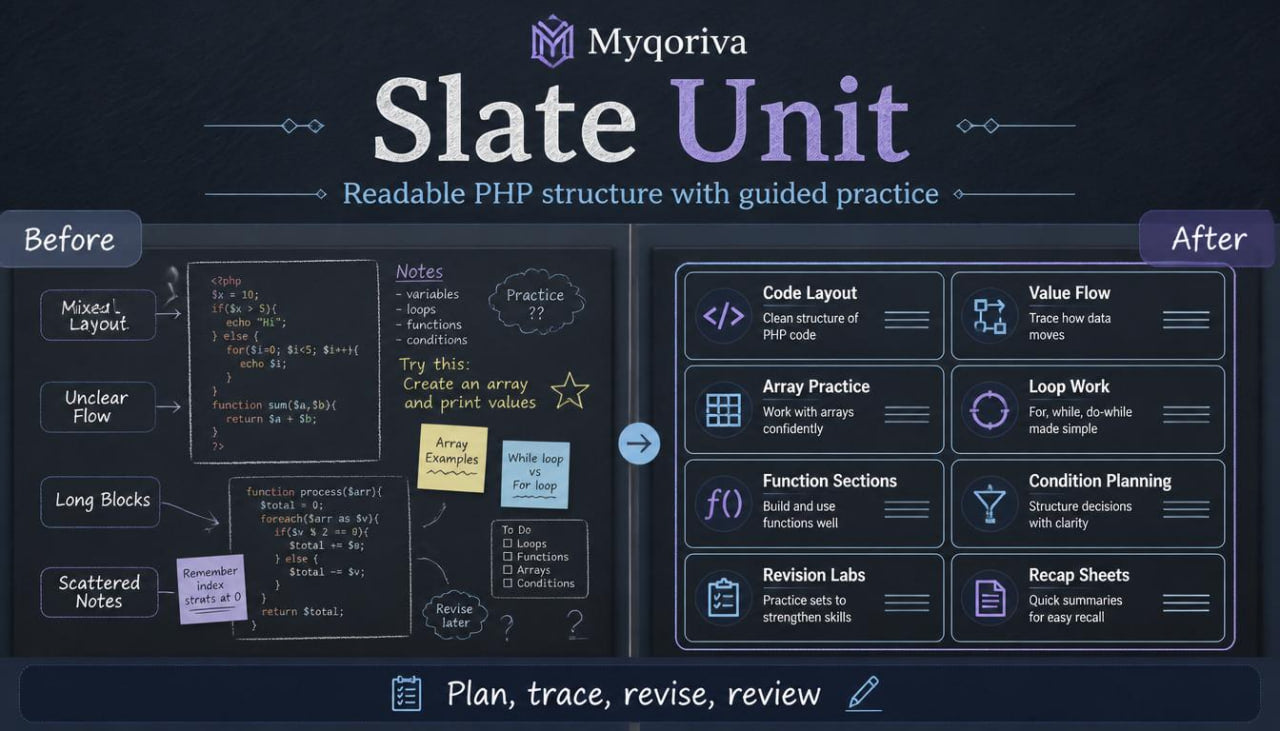
Slate Unit gives learners a practical written course path centered on readable PHP structure. The course shows how to arrange values, arrays, conditions, loops, and functions into study-friendly examples. Each module includes explanations, annotated scripts, rewrite tasks, review notes, and small practice sections. The materials help learners build skills by reading code carefully, tracing values, and adjusting examples step by step. This tariff is intended for learners who want a fuller PHP course tier while keeping the study process organized and grounded.
3. What’s Inside
Slate Unit begins with a section on code layout and reading order. Learners study how a PHP file can be divided into clear parts, such as setup values, grouped data, helper functions, checks, repeated output, and final display. The module explains how to move through a script without losing track of where a value begins and where it is used later. Each example includes side notes that describe the role of the section in plain wording.
The next module focuses on variables and value flow. Learners review how values are created, updated, compared, passed into functions, and displayed as output. The examples include text values, numeric values, true-or-false style checks, and small calculated results. Practice prompts ask learners to trace one value through several lines, explain what changes, and describe the final result.
A detailed array section comes next. This module covers indexed arrays, named-key arrays, and nested array structures through course-style examples. Learners study how grouped information can be stored under meaningful labels and then read later by a loop or function. The materials include examples with topic lists, task groups, note cards, and simple content sections. Each array example is followed by a shape note that explains how the structure is arranged before the script uses it.
Slate Unit also includes a strong loop module. Learners review repeated actions, loop counters, array reading, filtered output, and repeated display blocks. The course explains what changes during each loop round and how the script knows when to stop. Practice tasks include output prediction, missing-line completion, loop adjustment, and explanation prompts. This section helps learners understand repeated behavior as part of a full PHP structure.
The function module focuses on reusable code sections. Learners study how a function can receive values, apply a small rule, format a result, and return that result to another part of the script. Examples include title formatting, section labels, simple checks, repeated text blocks, and small number operations. The materials compare repeated code with function-based code, helping learners see how reusable parts can make a script easier to read and revise.
A condition planning module helps learners build clearer logic before writing PHP code. This section starts with plain-language rules and then turns them into PHP checks. Learners review single conditions, paired conditions, several branch paths, and nested checks. The examples show how the order of checks can affect which output appears. Practice prompts ask learners to rewrite rules, adjust conditions, and explain why one path runs instead of another.
Slate Unit includes a form-style values section. This part explains how named fields can relate to PHP values and how a script can check, organize, and display submitted information. The examples use neutral fields such as name, topic, note, selection, and message. Learners study how to check whether a value is present, how to prepare response text, and how to keep form-related code separated from display sections.
Another module focuses on small page structures. These examples combine arrays, loops, functions, and conditions in one study page. A sample page may contain a data group, a helper function, a loop that prepares repeated output, and a condition that changes a displayed note. Each page example begins with a planning outline, then shows the code, then explains the file in sections. This gives learners a repeatable way to approach longer examples.
Slate Unit also includes code revision labs. These labs show PHP examples that can be improved through clearer names, better grouping, smaller functions, or cleaner condition order. Learners are asked to revise the code in small steps. The course then explains why the revised version is easier to read. These labs support careful editing habits and help learners move beyond copying examples.
The course contains recap sheets throughout the material. These sheets include short explanations, comparison tables, common mistake notes, and review prompts. They compare topics such as variables and array values, loop rounds and output blocks, function input and returned results, or condition order and final display. Learners can use these sheets after each module or return to them later during review.
Slate Unit ends with a guided unit practice sequence. This final section brings together a planned PHP example with arrays, helper functions, checks, repeated output, and a final display block. Learners begin by reading the plan, then study the data, trace one value through the file, follow the loop behavior, and review the function result. The closing tasks ask learners to add a new data item, adjust a condition, rename a helper function, and explain how the output changes.
4. Who Is This For?
Slate Unit is for learners who already know core PHP ideas and want a clearer way to study structured scripts. It is suitable for students who have worked with variables, arrays, loops, conditions, and functions but want more practice connecting those parts. The course is also a good fit for learners who prefer written modules, annotated code examples, and guided revision tasks.
This tariff may suit learners who want to strengthen code reading habits. Slate Unit asks students to trace values, identify script sections, explain logic, and revise examples with care. It is also useful for people who want to study at their own pace, because each module can be reviewed separately and then connected through the final practice sequence.
Slate Unit keeps the focus on practical PHP study. It does not rely on exaggerated claims or pressure-based wording. Instead, it gives learners organized materials, clear examples, and repeated practice with the structures that appear often in PHP study.
5. What You’ll Learn
- How to divide a PHP file into readable sections
- How setup values, data groups, checks, helpers, loops, and output blocks connect
- How to trace values through several parts of a script
- How indexed arrays, named-key arrays, and nested arrays are arranged
- How loops read grouped information and prepare repeated output
- How to predict what a loop will display
- How functions receive values and return results
- How reusable code sections can reduce repeated lines
- How to plan PHP conditions with plain-language rules
- How different branch paths affect final output
- How form-style values can be checked and arranged
- How to build small page-style study examples
- How to revise unclear code into a cleaner structure
- How to compare similar PHP ideas during review
- How to explain a multi-part PHP file in your own words
6. 30-Day Refund Window
Slate Unit is a paid Myqoriva tariff, and a 30-day refund window may apply according to the store policy shown during checkout and on the refund information page. Learners should review the tariff description, included materials, topic range, and store terms before placing an order.
Self-paced learning overview
- 📁 Digital file available after purchase
- 🗂️ Long-term availability
- 🔐 Secure checkout
- 📝 Content updated in 2026
Do I need previous PHP knowledge before starting?
Do I need previous PHP knowledge before starting?
No previous PHP study is needed for the starting tiers. The early materials begin with basic ideas such as syntax, variables, values, conditions, loops, and code reading.
Can I study the course gradually?
Can I study the course gradually?
Yes. Each course is arranged into smaller sections, so you can move through the material step by step, return to earlier notes, and repeat practice tasks when needed.
What happens after I choose a tariff?
What happens after I choose a tariff?
After choosing a tariff, you receive the course materials included in that level. Each higher tariff adds wider topic coverage, more practice sections, and deeper review pages.
Share