Myqoriva
Vertex Collection
Vertex Collection
Couldn't load pickup availability
1. Problem Statement
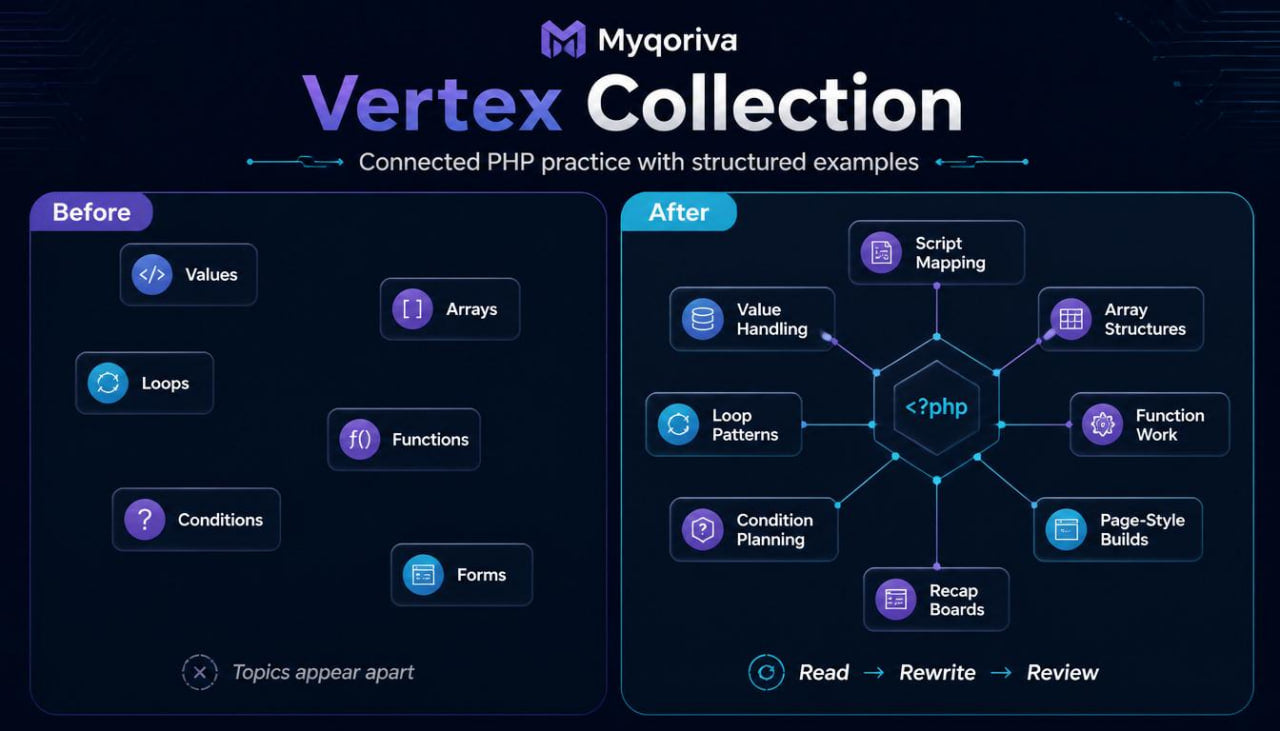
Many learners can read short PHP examples but feel unsure when several ideas appear together in one file. A script that uses arrays, loops, conditions, functions, and form-style values can become difficult to follow without a clear reading method. Learners may also struggle with arranging code into sections, choosing meaningful names, and knowing when repeated lines should become a reusable function. When practice materials are too scattered, it becomes harder to connect one topic with another and build a steady study rhythm. Vertex Collection was created for learners who want a broader PHP course tier with more connected tasks and detailed review sections.
2. Solution
Vertex Collection gives learners a structured PHP course path with written modules, guided examples, task sets, and recap pages. The tariff focuses on how code parts work together inside organized scripts, rather than presenting topics as disconnected fragments. Each module introduces a clear concept, shows it in context, and then gives learners practice prompts for reading, rewriting, and explaining the code. The course supports careful study through repeated patterns, comparison notes, and multi-step examples. This tier is intended for learners who want deeper PHP materials while keeping the study process calm, readable, and practical.
3. What’s Inside
Vertex Collection begins with a module on script mapping. This section teaches learners to look at a PHP file as a set of connected areas: setup values, grouped data, helper functions, condition checks, repeated output, and final display sections. Instead of treating code as a wall of lines, learners are guided to identify the purpose of each part. The module includes annotated examples where every section is labeled and explained in plain wording.
The next part focuses on stronger variable and value handling. Learners review text values, number values, boolean-style checks, and calculated values inside practical examples. The materials show how a value can be created, changed, compared, passed into a function, or displayed in output. Practice tasks ask learners to trace a value through several lines and explain how it affects the script result.
A large array module forms one of the central parts of Vertex Collection. This section covers indexed arrays, named-key arrays, and nested array structures in a study-friendly format. Examples include topic groups, content cards, simple settings, task lists, and course-style sections. Learners study how data can be arranged under meaningful keys and how this structure can make repeated output easier to manage. Each example includes a breakdown of array shape, key names, selected values, and output behavior.
The course then moves into loops with array-driven examples. Learners study how repeated actions can display several values, filter a list, or prepare repeated blocks of content. The materials explain how each loop begins, what value changes during each round, and how the final output is formed. Practice prompts include output prediction, missing-line completion, loop rewriting, and plain-language explanation tasks.
Vertex Collection also includes a deeper function section. Learners study how reusable code blocks can receive values, process them, and return a result. The examples include formatting labels, checking small rules, preparing text blocks, and calculating simple totals. The course compares repeated code with function-based code so learners can see how reusable sections can make a PHP file more organized. Tasks ask learners to complete parameters, adjust returned values, and rewrite repeated lines into a cleaner function pattern.
A separate module focuses on condition planning. Learners study how to arrange checks in a readable order before writing the PHP code. The materials include examples with single checks, paired checks, grouped conditions, and nested branches. Each topic begins with a plain-language rule, then shows how that rule can be written as PHP logic. This helps learners connect human-readable planning with code structure.
Vertex Collection also includes a form-style workflow section. This module explains how named fields can relate to PHP values, how submitted information can be checked, and how output can be prepared after the check. The examples are neutral and use sample fields such as name, topic, note, option, and message. Learners practice checking whether values are present, shaping response text, and keeping form-related logic readable.
Another part of the course introduces small page-style builds. These are guided study examples that combine multiple PHP ideas in one file. A page-style example may include an array of items, a helper function, a loop for output, and conditions that adjust what is displayed. The examples are not large systems. They are focused study pages designed to show how PHP concepts can work together in a practical and organized way.
The course also includes rewrite labs. These labs present code that can be improved through clearer names, better grouping, reusable functions, or cleaner conditions. Learners are asked to revise the example step by step and then compare the revised version with the explanation notes. This helps learners develop stronger code reading and editing habits.
Vertex Collection contains recap boards throughout the course. Each board includes short definitions, small examples, comparison notes, and common mistake reminders. The boards cover arrays, loops, functions, conditions, form-style values, and file sections. They are made for repeated review and can be used before starting a new module or after completing a task set.
The course ends with a guided collection project for study practice. This final section brings together arrays, loops, functions, and conditions inside one structured PHP example. Learners begin by reviewing the plan, then examine the data, read the helper function, follow the logic, and study the output. The closing tasks ask learners to add a new array item, adjust a condition, rename a function, and explain the revised script in writing.
4. Who Is This For?
Vertex Collection is for learners who already know the basics of PHP and want a wider course tier with more connected practice. It fits students who have studied variables, arrays, loops, conditions, and functions, but want to understand how these parts can work together inside one structured file. The course is also suitable for learners who prefer written modules, annotated examples, and task-based review.
This tariff may be helpful for learners who want to improve how they read PHP files. The materials focus not only on writing code but also on tracing values, identifying sections, explaining logic, and revising examples. This makes the course useful for people who want a more thoughtful approach to PHP study.
Vertex Collection also works well for self-paced learners who enjoy organized materials. Each module can be studied on its own, while the recap boards and rewrite labs help connect earlier topics with later ones. The tariff gives learners more depth than the earlier tiers while keeping explanations clear and manageable.
5. What You’ll Learn
- How to read a PHP file as a group of connected sections
- How setup values, arrays, functions, conditions, loops, and output areas work together
- How to trace values through several lines of PHP code
- How indexed arrays, named-key arrays, and nested arrays are arranged
- How loops can display and filter grouped values
- How reusable functions receive values and return results
- How to rewrite repeated code into a reusable structure
- How to plan conditions before writing them
- How plain-language rules become PHP checks
- How form-style values can be checked and displayed
- How to organize small page-style examples
- How to improve variable names, function names, and array keys
- How to use recap boards for repeated review
- How to revise PHP examples without losing their structure
- How to explain a multi-part script in your own words
6. 30-Day Refund Window
Vertex Collection is a paid Myqoriva tariff, and a 30-day refund window may apply according to the store policy shown during checkout and on the refund information page. Learners should review the tariff description, included materials, topic coverage, and store terms before placing an order.
Self-paced learning overview
- 📁 Digital file available after purchase
- 🗂️ Long-term availability
- 🔐 Secure checkout
- 📝 Content updated in 2026
Do I need previous PHP knowledge before starting?
Do I need previous PHP knowledge before starting?
No previous PHP study is needed for the starting tiers. The early materials begin with basic ideas such as syntax, variables, values, conditions, loops, and code reading.
Can I study the course gradually?
Can I study the course gradually?
Yes. Each course is arranged into smaller sections, so you can move through the material step by step, return to earlier notes, and repeat practice tasks when needed.
What happens after I choose a tariff?
What happens after I choose a tariff?
After choosing a tariff, you receive the course materials included in that level. Each higher tariff adds wider topic coverage, more practice sections, and deeper review pages.
Share